-
 By Matthew
- February 18, 2026
- 0 Comments
- Uncategorized
What would an Integrated MTSS (I-MTSS) look like?
Multi-Tiered Systems of Support, or MTSS, is often described as a way of organising support across three levels: universal support for all students, targeted support for some students, and intensive support for students with more complex needs. This explanation is useful, but it can also make MTSS appear simpler than it is.
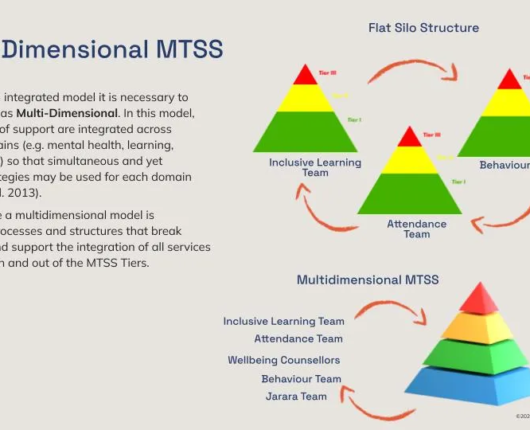
In practice, MTSS can mean very different things. Sometimes it is used as an umbrella term for separate tiered approaches to learning, behaviour, wellbeing or attendance. At other times, it refers to a more integrated organisational framework that brings these areas together through shared leadership, common data routines, coordinated decision-making and aligned support pathways.
This distinction matters. When MTSS is treated only as a collection of separate initiatives, schools risk duplicating processes, diffusing responsibility and reinforcing siloed responses to student need. Students may be moved through different tiers of support without enough attention to the barriers, relationships and contexts shaping their participation.

A more coherent approach is needed. An integrated MTSS is not simply a collection of domain specific tiered interventions. It is a layered system that connects inclusive purpose, school and system infrastructure, and everyday implementation routines. Understanding these three layers helps clarify what MTSS is, what it is intended to organise, and how it can support more consistent, equitable and responsive practice across schools.
An I-MTSS framework organises MTSS across three analytically distinct but interdependent layers: (1) normative foundations, the why for MTSS; (2) structural enablers, the what of MTSS; and (3) implementation processes, the how if MTSS. This layered model reflects the progression evident in international scholarship from programmatic descriptions of tiered interventions toward system-level governance, ecological responsiveness, and implementation coherence (Sailor et al., 2020; Santiago et al., 2024; Kearney & Graczyk, 2020).
Layer 1: Normative foundations
At its heart, MTSS is built on three simple ideas.
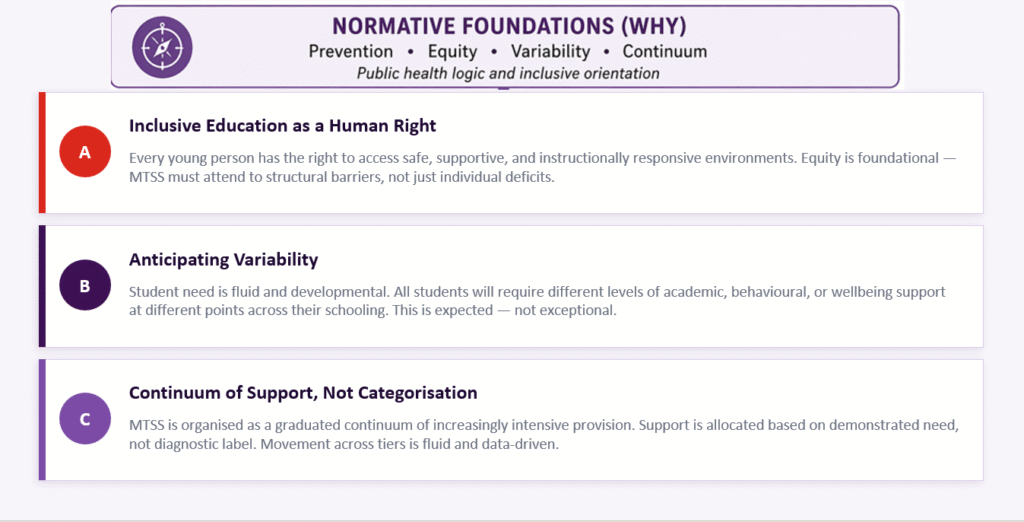
First, every student has the right to learn in a safe, supportive and responsive school environment. MTSS should not be about waiting for students to fail before support is provided. It should help schools identify barriers early and make sure students can access the support they need to participate, belong and succeed.
Second, student need changes over time. Students do not fit neatly into fixed categories. A student may need extra support with learning at one point, wellbeing at another, and attendance or engagement at another. MTSS recognises that support needs to be flexible because student development is not always linear.
Third, MTSS is a continuum of support, not a labelling system. The purpose is not to sort students into tiers. The purpose is to provide the right level of support at the right time. Some students will need universal support only. Others will need more targeted or intensive support for a period of time. As needs change, support should be reviewed and adjusted.
These three ideas matter because they keep MTSS focused on inclusion, prevention and responsiveness. They remind us that MTSS is not just a system for managing difficulty after it appears. It is a way of organising schools so that support is available early, consistently and equitably.
Layer 2 Structural enablers
The second layer of MTSS is about the structures that help the system work in a coordinated and sustainable way. MTSS cannot rely only on good intentions or individual teacher effort. It needs the right school and system conditions around it. Research on MTSS and implementation science shows that these structures are what help MTSS become an integrated approach, rather than a collection of separate programs or short-term initiatives (Choi et al., 2022; Sailor et al., 2021; Brown-Chidsey, 2024; Collier-Meek et al., 2026; Graczyk & Kearney, 2024).
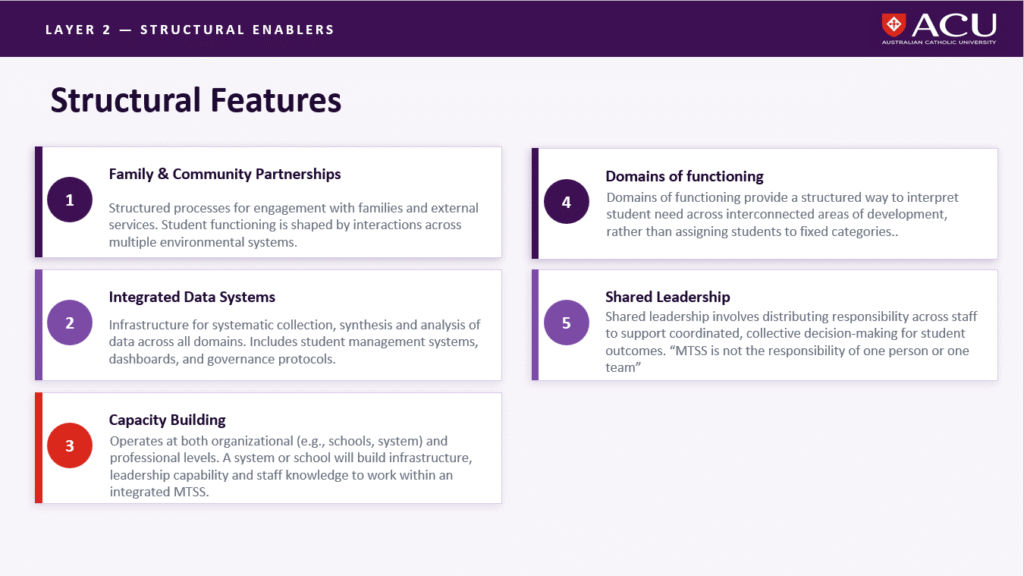
A useful way to think about this layer is through five connected features.
Understanding student need across domains
At the centre of an integrated MTSS is a broad understanding of student functioning. Students do not experience learning, behaviour, wellbeing, attendance, culture and health as separate parts of their lives. These areas often overlap.
For this reason, MTSS needs a way to understand student need across several domains, including:
-
- Learning and cognitive development.
-
- Connectedness, belonging, access and safety.
-
- Behaviour regulation and engagement.
-
- Social, emotional and mental health.
-
- Spiritual and cultural functioning.
-
- Physical, sensory and health functioning.
These domains are not fixed labels. They are a way of helping schools look beyond categories such as “learning difficulty”, “behaviour problem” or “attendance issue”. They encourage staff to ask a more useful question: what is affecting this student’s participation, learning and wellbeing?
This matters because student need is shaped by many interacting factors, including personal, relational, cultural, family, school and community conditions.
Shared leadership and responsibility
MTSS also depends on shared leadership. It should not sit with one person, one team or one area of school practice. Responsibility for learning, engagement and wellbeing needs to be coordinated across the school.
This means leadership structures should work across domains, rather than creating separate teams for academic support, behaviour, wellbeing and attendance that operate in isolation (Billingsley et al., 2018; Latimer, 2022; Winston, 2026).
When leadership is shared and accountability is clear, schools are less likely to duplicate work or send students through disconnected support pathways. This supports more consistent decision-making and a clearer sense of collective responsibility (Crim, 2023; Kittelman et al., 2021).
Integrated data systems
MTSS relies on good information. Schools already collect a lot of data about students, including learning progress, attendance, behaviour, wellbeing, disability adjustments and engagement. The challenge is that this information is often held in different places and used by different teams.
An integrated MTSS needs data systems that bring information together in ways that are organised, accessible and useful for decision-making (Scott et al., 2019; Lachat & Smith, 2024; Taylor & Burgess, 2023). This might include student management systems, dashboards, screening tools, progress monitoring processes and shared review routines.
Just as importantly, schools need clear rules about how data are collected, accessed and used. Good data systems are not just technical tools. They are part of the governance of MTSS (Clutterbuck et al., 2023; Hillman, 2023; White, 2022). Their purpose is to help staff see patterns, interpret need and make better decisions about support (Wilson et al., 2025).
Building staff and system capacity
MTSS also requires capacity building. Staff need the knowledge, confidence and skills to work within an integrated system. This includes understanding how to identify student need, interpret data, select evidence-informed supports and monitor whether those supports are making a difference.
Capacity building happens at two levels. At the system level, it includes leadership development, infrastructure, common processes and implementation support. At the professional level, it includes staff learning, coaching, collaboration and shared problem-solving (Choi et al., 2019; Sugai et al., 2016; Freeman et al., 2017; Sailor et al., 2021).
Without capacity building, MTSS can easily become another policy expectation placed on schools. With the right capacity building, it becomes a practical way to organise the work schools are already doing.
Family and community partnerships
Finally, MTSS needs to extend beyond the school gate. Student learning, behaviour, attendance and wellbeing are shaped by relationships between students, families, schools, communities and services.
This reflects Bronfenbrenner’s bioecological perspective, which emphasises that development is shaped by interactions between people and their environments over time (Bronfenbrenner, 1992).
For schools, this means that student need cannot be fully understood from classroom data alone. Families and communities hold important knowledge about students’ lives, strengths and challenges. When needs are complex or span multiple domains, schools also need structured ways to collaborate with external services (Hart et al., 2024; Hendricker et al., 2023; Weingarten et al., 2020).
Level 3: Implementation Processes
The third layer is about how MTSS works in everyday school practice. If the first layer explains the purpose of MTSS, and the second layer explains the structures needed to support it, this third layer explains what schools actually do.
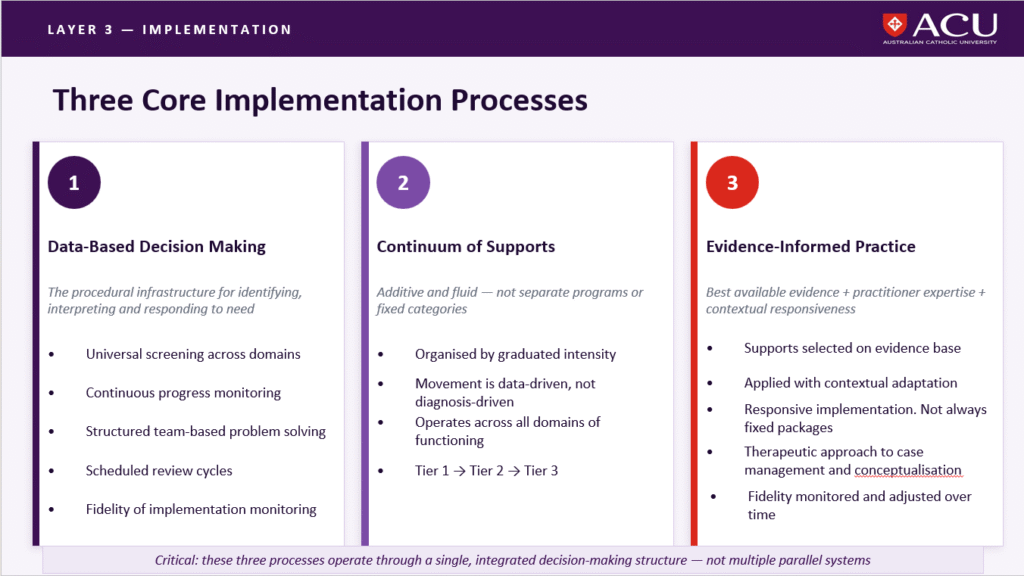
MTSS is enacted through three core processes: data-based decision making, a continuum of supports and interventions, and the use of evidence-informed practices. These processes are consistently identified in MTSS literature as central to effective implementation (McIntosh & Goodman, 2016; Sailor et al., 2018; Sailor et al., 2020; Vetter et al., 2024).
Data-based decision making
Data-based decision making is the process schools use to identify, understand and respond to student need. It means decisions are not based only on referral, concern or crisis. Instead, schools draw on multiple sources of information to understand what is happening for students and what support may be required.
This usually includes universal screening, progress monitoring, structured team discussion, regular review cycles and attention to whether supports are being implemented as intended.
In simple terms, schools need to ask:
-
- What do we know?
-
- What does the data suggest?
-
- What might be affecting the student’s participation, learning or wellbeing?
-
- What support is needed?
-
- How will we know whether the support is working?
This process is important because it helps schools move beyond one-off responses. It creates a routine way to notice need early, interpret it carefully and respond consistently across learning, behaviour, attendance, wellbeing and other areas of student functioning.
A continuum of supports and interventions
MTSS also depends on a continuum of support. This means support is organised by intensity, not by fixed categories.
Some students will be supported well through high-quality universal practice. Others may need additional targeted support for a period of time. A smaller number of students may need more intensive and individualised support.
Importantly, the continuum should be fluid. Students should not be placed in a tier and left there. Movement between levels of support should be based on need, progress and regular review.
This also means that supports should not operate as separate programs. In an integrated MTSS, the continuum applies across domains of functioning. A student may need targeted learning support, intensive attendance support, and universal wellbeing support at the same time. The system should be able to coordinate these supports rather than treating them as separate issues.
Evidence-informed practice
The third process is the use of evidence-informed practice. This means schools select supports based on the best available evidence, while also considering professional judgement, student context, family knowledge and local conditions (Linan-Thompson et al., 2022; Owen et al., 2022; Stoiber & Gettinger, 2015).
Evidence-informed practice is not the same as applying a program in a rigid way. A strategy may have strong evidence behind it, but it still needs to be appropriate for the student, the context and the purpose of support.
This is why MTSS requires both evidence and professional reasoning. Schools need to know what is likely to work, but they also need to understand why a particular support is appropriate, how it should be implemented, and whether it is making a difference.
Why these processes need to be integrated
The most important point is that these processes should not sit inside separate systems. Schools should not have one decision-making process for learning, another for behaviour, another for attendance and another for wellbeing.
An integrated MTSS uses common routines across domains. The same broad process is used to identify need, interpret information, select supports, monitor progress and review decisions. This supports more consistent practice and reduces the risk of students being moved between disconnected systems (Choi et al., 2024).
In this sense, MTSS is not only about what supports are available. It is about how schools make decisions. When implementation processes are clear and integrated, schools are better able to respond early, coordinate support and adjust practice as student needs chang