-
 By Matthew
- May 22, 2026
- 0 Comments
- Implementation, Research
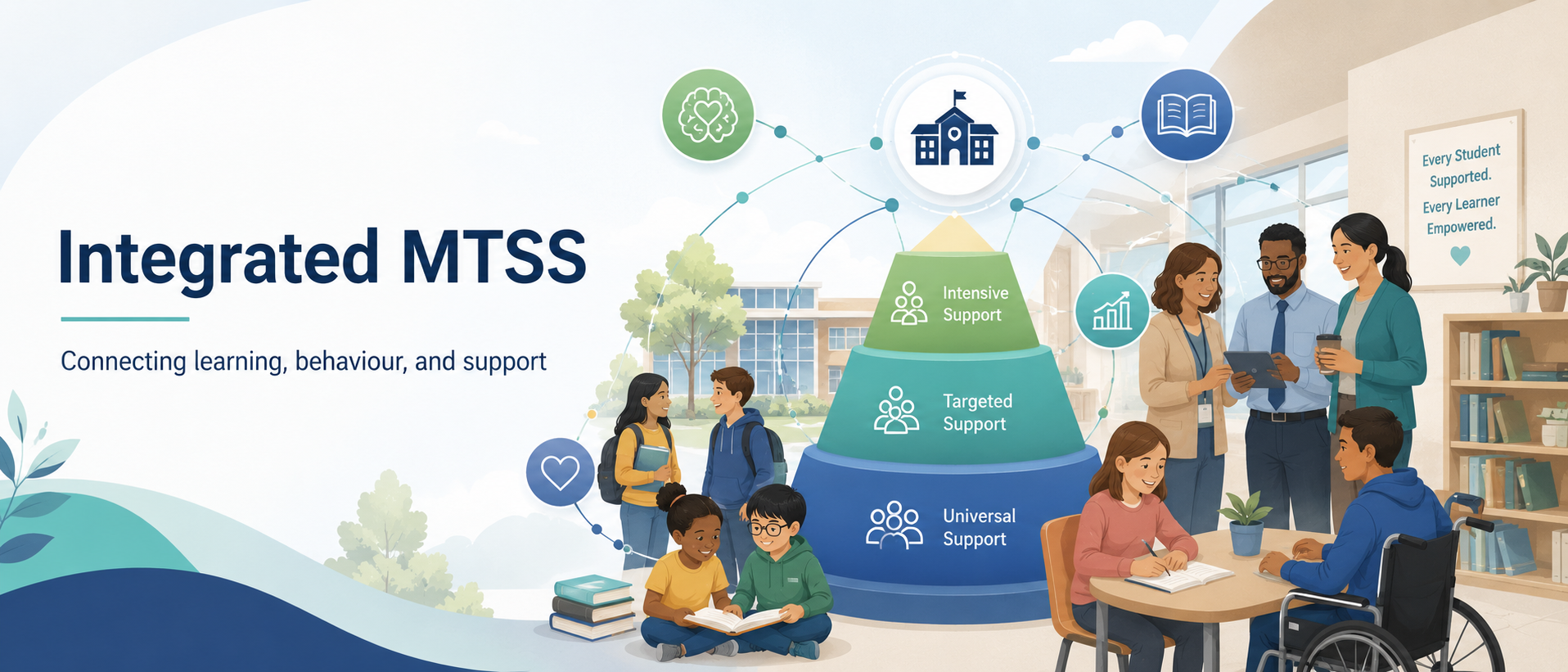
Many schools working within a Multi-Tiered System of Supports framework have two distinct implementation systems running side by side. One focuses on behaviour. The other focuses on academic learning. Each has its own fidelity measures, its own teams, its own professional development, and its own improvement cycle.
This makes practical sense. Schools are complex places, and different student needs often require different expertise.
But it also creates a problem. If every area of support is planned, measured, and implemented separately, schools can end up with multiple support systems running side by side. Staff may use different language, different data, different referral pathways, and different decision-making processes. The result can be a collection of separate initiatives rather than a coherent whole-school system.
This arrangement is not accidental. It reflects the history of how MTSS developed, with school-wide positive behaviour support and academic intervention growing largely in parallel, each with strong research traditions and dedicated tools. But it raises a persistent question: if students do not experience their behaviour and learning as separate problems, why do schools organise support as if they do?
A recent study by Santiago and colleagues (2025) takes a careful look at this question, and the findings are both encouraging and a pause for consideration.
What the study examined
The researchers used implementation data from 225 schools in a Midwestern U.S. state. Each school had completed fidelity measures for three areas of MTSS: school-wide behaviour support, reading, and mathematics. The study focused on Tier 1, the universal level of support intended for all students.
Rather than asking whether MTSS improved outcomes directly, the researchers examined whether behaviour and academic implementation shared a common underlying structure. Simply, they looked at when schools implement these systems well, are they drawing on the same organisational foundations?
The encouraging finding
The answer was largely yes. The study identified an overall implementation factor that cut across behaviour, reading, and mathematics support. Schools that implemented one domain well tended to implement others well too, suggesting they were drawing on shared organisational capacity.
That shared capacity likely includes things such as leadership structures, teaming processes, data routines, and evaluation practices. None of these belong exclusively to behaviour or to academics. They are features of how the school as an organisation functions.
This is an important finding. It gives empirical support to the argument that integrated MTSS is not simply about labelling existing programs under a common banner or an umbrella. There appear to be genuine shared foundations that connect behaviour and academic support systems at the implementation level.
The sobering finding
Here is where the study presents us with a real challenge.
Despite identifying this shared implementation factor, the researchers found no relationship between overall implementation quality (fidelity) and school-level achievement in reading or mathematics.
I don’t think we can take this as MTSS implementation fidelity does not matter. But it does mean that having systems in place, and measuring them with fidelity tools, is not by itself sufficient to produce measurable gains in student outcomes. The relationship between implementation quality and what students actually experience and achieve is more complex, and more distant, than fidelity measures alone can capture.
This finding sits uncomfortably alongside some of the assumptions that drive MTSS adoption. Systems are often justified to school communities partly on the basis that better implementation leads to better results. The evidence here suggests that connection is neither simple nor guaranteed. Maybe we need to be looking locally and towards context driven evidence informed implementation instead of standard protocols. At the same time I do not advocate that fidelity does not matter. However, if we look at the literature regarding implementation science it is clear that evidence informed implementation does take into account local constraints, needs and influences. What worked in one school is not necessarily going to be transcribed across a system.
Maybe we need to be looking locally and towards context driven evidence informed implementation instead of standard fidelity driven protocols.
Is there evidence for an Integrated MTSS?
The study also reveals something important about the limits of current integration. While a shared implementation factor did emerge, the behaviour measure was far less strongly explained by that factor than the reading and mathematics measures were.
In practical terms, this means behaviour support and academic support may still be operating more independently than an integrated model requires. Reading and mathematics were closely aligned in the data, perhaps because they use similar tools and share similar team structures. Behaviour support appears to sit somewhat apart.
This matters because genuine integration is not just about efficiency or shared language. It is about whether schools can respond to students whose needs cut across behaviour, learning, wellbeing, and attendance at the same time. A framework that measures integration but still reflects two underlying systems is not yet delivering on that promise.
Is there evidence for an Integrated MTSS?
The study focused only on Tier 1 systems. Many of the hardest integration challenges occur at Tiers 2 and 3, where students need more intensive and coordinated support, often involving multiple staff, families, and external services. We do not yet know whether the same shared implementation factor exists at those levels, or whether the separation between behaviour and academic systems becomes more pronounced as support intensity increases.
The study also cannot tell us what the shared implementation factor actually contains. Leadership, collaboration, data use, and organisational routines are all plausible candidates. But without a clearer definition of what integration looks like in practice, it is difficult to know what schools and systems should specifically build or strengthen.
Reference: Santiago, R. T., Hall, G. J., Garbacz, S. A., Gulbrandson, K., & Albers, C. A. (2025). Examining an integrated factor structure of schoolwide MTSS implementation measures. Journal of Positive Behavior Interventions, 27(1), 39–49. https://doi.org/10.1177/10983007241249524